
ASELSAN Showcases Integrated Response to UAV Threats

Drone defence has moved from a specialist military requirement to a shared concern for border agencies, police forces, airport operators, critical infrastructure owners and event security planners. Small unmanned aerial systems can be used for observation, disruption or payload delivery, while their low cost and fast iteration cycles make them difficult to manage through conventional air-defence logic alone. The result is a demand for systems that can detect, classify, track and respond to a spectrum of aerial risks, while operating within legal and safety constraints.
Against this backdrop, over two days in early June, ASELSAN successfully demonstrated its integrated Drone Defense System in the presence of the media and delegations from 20 countries. The Turkish defence electronics company, which was an exhibitor at Milipol Paris 2025, used the demonstration to show the coordinated use of İHTAR, GÖKBERK and EJDERHA against mini and micro UAV threats. The demonstration also reflected ASELSAN’s broader positioning as Türkiye’s largest defence electronics company, active across defence and security technologies.
Counter-UAV Systems Become a Layered Security Requirement
Modern counter-UAV planning increasingly relies on integration rather than a single sensor or effector. The US Cybersecurity and Infrastructure Security Agency has described the value of integrating UAS detection technology into existing security plans to support a layered approach to protection. Research and doctrine-focused assessments point in the same direction, emphasising that detection, identification, decision support and mitigation must be combined if security teams are to reduce false alarms and respond proportionately.
This layered model matters because drone incidents do not present one uniform problem. A recreational aircraft flying near an airport, a modified quadcopter near a prison, a surveillance drone over a sensitive industrial site and a coordinated attack using multiple UAVs all require different responses. A purely kinetic answer may be excessive or unlawful in some civilian environments, while a purely electronic response may be insufficient where drones are autonomous, hardened or operating in congested radio-frequency conditions.
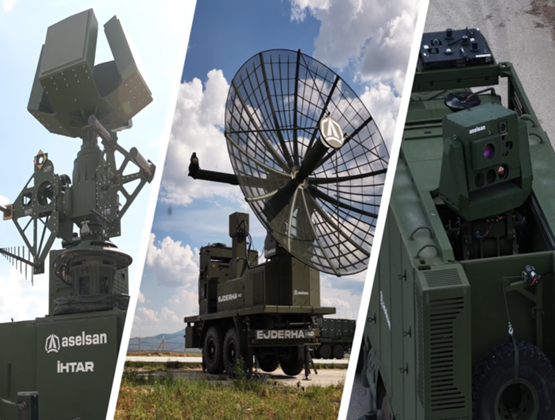
ASELSAN’s June demonstration therefore addressed a core operational question: how can a security authority move from awareness to action without creating new risks? According to ASELSAN, its AI-supported Drone Defense System (DRONEDEF) provides protection against mini and micro UAV threats in mobile and integrated configurations, including the protection of areas and facilities, with a detection range of 10 km. The live event presented ASELSAN’s counter-UAV portfolio as part of the lower tier of Türkiye’s Steel Dome air-defence architecture, combining soft-kill and hard-kill measures against mini and micro UAV threats.
Inside ASELSAN’s Integrated Drone Defense System
The demonstration brought together three central components. İHTAR provides the core counter-UAV layer, supporting the detection, tracking and response process against small drone threats. GÖKBERK adds a directed-energy hard-kill capability, using laser technology to physically defeat selected targets when electronic measures are not sufficient or appropriate. EJDERHA contributes a high-power microwave effect, broadening the system’s ability to address mini and micro UAVs across different threat scenarios.
The significance lies not simply in the individual technologies, but in their coordination. Counter-drone systems must compress the time between detection and response. Operators need to know whether an aerial object is present, whether it is authorised, where it is going and what response is permissible. A system that fuses multiple sensors and effectors can give decision-makers a broader set of options, ranging from monitoring to disruption and physical defeat.
ASELSAN has also connected its counter-UAV portfolio to a wider air-defence architecture. Reuters reported in May 2026 that ASELSAN planned to increase its delivery of components for Türkiye’s Steel Dome air-defence system, including early-warning radars, electronic warfare systems and drone countermeasures. That framing is important for homeland security audiences because many threats now sit between policing and defence. Low-altitude airspace over cities, ports, borders and energy sites increasingly requires a common operating picture shared between civil authorities, law enforcement and defence-linked organisations.
The June demonstration also followed ASELSAN’s unveiling of additional electronic warfare and counter-UAV solutions this year, with new versions of KORAL, ILGAR and EJDERHA, and a 10kW version of GÖKBERK. This suggests that counter-drone capability is being treated as part of a larger electronic and air-defence ecosystem, rather than as a standalone perimeter product.
From Communications Roots to International Security Markets
ASELSAN was established in 1975 to meet the communication equipment requirements of the Turkish Armed Forces. Its subsequent development has taken it into areas including communications, radar, electro-optics, electronic warfare, air defence, naval systems and security technologies. The company describes itself as an international defence electronics provider offering solutions from under the sea to outer space.
That breadth is relevant to the drone-defence market. Counter-UAV systems are not isolated products. They draw on radar engineering, electro-optical surveillance, command-and-control software, electronic warfare, power management and platform integration. A company with experience across these domains can package sensors and effectors into more complete architectures for fixed sites, vehicles and deployable units.
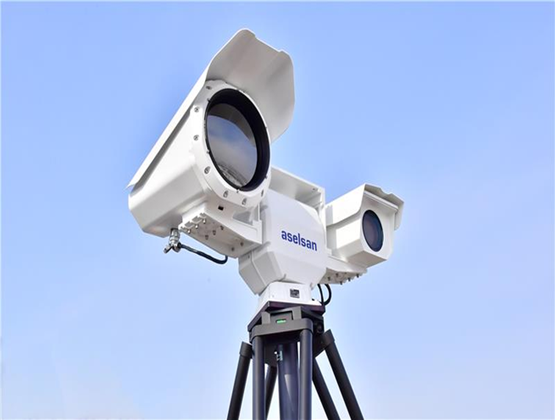
ASELSAN’s recent exhibition activity also places these technologies in front of homeland security decision-makers. At Milipol Paris 2025, one of the products the company showcased was its ODAKAN UMA 8T10, a surveillance camera system combining day and thermal imaging for land and maritime operations, with AI-powered analytics, automatic detection and tracking. The company’s planned presence at Milipol Qatar extends that engagement into the Gulf security market. Milipol Qatar is scheduled to take place from 20 to 22 October 2026 at the Doha Exhibition and Convention Center.
For homeland security agencies, ASELSAN’s June demonstration shows that counter-drone capability is becoming an architecture rather than a device. The challenge is to combine awareness, legal clarity, proportionate response and interoperability. ASELSAN’s integrated Drone Defense System offers one example of how industry is trying to answer that requirement through layered detection, soft-kill and hard-kill capability.
Image credits:
Daniel Robert Dinu - Unsplash
ASELSAN