
Automated services and AI-enabled response in the UAE

The United Arab Emirates has become one of the most closely watched examples of AI-enabled law enforcement in the Gulf. Its approach is rooted in the safe-city model, where public security, traffic management, emergency response and critical infrastructure protection are increasingly linked through data platforms. In Dubai, this has taken shape through Oyoon, Arabic for “eyes”. In Abu Dhabi, Falcon Eye performs a comparable role through a centralised surveillance architecture. Although the names are sometimes used together, they refer to distinct systems operating in different emirates, with a shared emphasis on AI-assisted monitoring and police response.
From CCTV to Connected Urban Intelligence
Traditional CCTV depends on human operators watching, interpreting and escalating incidents. Oyoon and Falcon Eye reflect a different operating model. Their purpose is not simply to collect video, but to structure it, analyse it and turn it into alerts that police and public safety agencies can act on quickly.
Dubai Police launched Oyoon in 2018 as an AI surveillance programme intended to prevent crime, reduce traffic accidents and improve response to incidents before they are formally reported. The system was described at launch as involving tens of thousands of cameras equipped with facial recognition software and microphones, supported by government, semi-governmental and private-sector partners. Its uses include identifying suspects, tracking vehicles and licence plates, detecting criminal behaviour and supporting minor traffic enforcement.
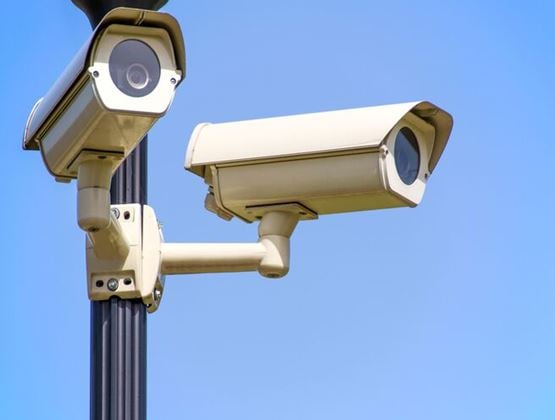
The operational significance lies in integration. Cameras across tourist destinations, public transport, roads and commercial areas can feed into central command structures. In 2019, a Dubai Police official said thousands of CCTV cameras under Oyoon had helped arrest 319 suspects during the previous year, with more than 5,000 cameras covering the Metro alongside other citywide feeds.
Falcon Eye and the Abu Dhabi Safe-City Model
Abu Dhabi’s Falcon Eye sits within a broader safe-city framework. The Abu Dhabi Monitoring and Control Centre launched the project to install and integrate cameras and sensors across the city, enabling real-time situational awareness, threat detection, data collection and information sharing among public safety organisations.
The system expands Abu Dhabi’s surveillance network through licence plate recognition cameras and public surveillance cameras equipped with video analytics and, in some cases, facial recognition capabilities. FLIR, whose video management system has been used as a central component, described the platform as integrating public access cameras into a single system for uninterrupted city coverage. Across Abu Dhabi, the network has been reported to include more than 45,000 sensors, combining licence plate recognition, facial recognition, video analytics and video management into a single operational picture.
This type of architecture is significant for homeland security because it brings policing closer to other urban functions. Traffic incidents, suspicious behaviour, movement near sensitive sites and vehicle-based alerts can be processed in the same operational environment. The result is a city security model that prioritises speed, pattern recognition and cross-agency coordination.
From Surveillance to Smart Policing
For law enforcement agencies, the appeal of AI surveillance lies in its ability to reduce the burden on control-room staff, search large video networks faster than human teams, and support quicker decisions during time-sensitive incidents. In dense cities with major tourism flows, transport hubs and critical assets, this can strengthen both prevention and response.
Dubai’s wider policing model shows how surveillance, AI and public service automation are beginning to converge. Its Smart Police Stations are fully automated, officer-free facilities that operate 24 hours a day, allowing residents and visitors to report crimes, pay fines, submit lost-item reports, request certificates and access other police services through self-service systems. The model reduces paperwork, speeds up routine procedures and allows police services to be placed in more locations without the staffing requirements of a conventional station.
That approach is set to extend beyond land-based facilities. Dubai Police has announced plans for a floating Smart Police Station near the World Islands, expected to be operational by the end of 2026. The facility is designed to serve yacht owners, boat users and the wider maritime community, with 27 primary services and 33 additional services available in six languages. Its development reflects a broader shift in which policing is not only becoming more digital, but also more mobile, distributed and accessible across different urban environments.
In this context, Oyoon sits within a policing ecosystem that combines automated service points, connected cameras, identity verification, licence-plate recognition and AI-assisted detection. For public safety agencies, the attraction is faster access to services, quicker incident reporting, improved coverage in remote or high-traffic areas, and reduced pressure on frontline personnel. Solar-powered stations also bring a sustainability dimension to the safe-city model, linking operational efficiency with Dubai’s wider smart-city ambitions.
The same level of automation also increases the importance of governance. When camera analytics, biometric tools and self-service policing become part of everyday public infrastructure, confidence depends on clear safeguards. Data retention, audit trails, human review and proportionality become operational requirements rather than abstract legal concerns. The challenge for AI-enabled policing is therefore not only whether systems can detect more or respond faster, but whether they can do so in a way that remains accountable, explainable and trusted.

A Test Case for AI Governance in Policing
The UAE’s surveillance and other policing projects sit within a larger national ambition to embed AI across government services, mobility, infrastructure and public safety. Analysts have noted that Oyoon and Falcon Eye illustrate how smart-city AI can extend into security and law enforcement, using thousands of cameras to analyse criminal activity through facial recognition and behavioural interpretation.
As police forces, civil protection agencies and technology providers assess the future of AI-enabled urban security, the UAE offers a prominent case study in both ambition and complexity. The next stage of discussion will focus on how such systems can support safer cities while preserving trust, accountability and lawful use. Those questions remain central to the security technologies and public safety debates brought together at Milipol Paris.
Image credits:
Fabien Bellanger - Unsplash
AS Photography - Pexels
Steve A Johnson - Unsplash