
AIRBUS ALIACA GOES VERTICAL

The ability to put an airborne sensor beyond a ship’s immediate field of view has become an increasingly valuable part of maritime surveillance. For the French Navy, the U010 Aliaca has already provided that additional perspective from patrol vessels and surveillance frigates. Now, its operating envelope is widening.
Following trials conducted in 2024 and 2025, France’s Directorate General of Armament, the DGA, has ordered the vertical take-off and landing, or VTOL, version of Airbus Helicopters’ U010 Aliaca. The change removes one of the principal physical constraints surrounding the existing system: the need for a catapult to launch the aircraft and a net to recover it.
It is a relatively modest alteration in appearance, but one with potentially significant operational consequences.
Taking Surveillance To Smaller Decks
The original Aliaca has been operated by the French Navy since 2022 under the SMDM, or Onboard Mini Aerial Drone Systems for the Navy, programme. Earlier trials stretch back further, with the system first operated from an offshore patrol vessel in 2019. Subsequent orders expanded its deployment across offshore and overseas patrol vessels and surveillance frigates.
In that configuration, the drone became what the French Navy has described as a form of remote binoculars. Flying beyond a vessel’s radar horizon, it can provide imagery and information without requiring the launch of a crewed helicopter.
The VTOL configuration changes the type of platform from which those binoculars can be used. Trials conducted by the French Naval Aviation Practical Trials and Acceptance Centre included operations from a Metropolitan Support and Assistance Vessel, or BSAM, a type of ship that had not originally been designed to deploy drones. The first VTOL systems are expected to enter service on BSAMs in late 2026, followed by Overseas Support and Assistance Vessels, known as BSAOMs, during 2027.
By dispensing with a launch catapult and recovery net, the aircraft requires less dedicated deck infrastructure. Airbus also reports that preparation can take only a few minutes and that vertical recovery allows operations in sea conditions in which capturing the aircraft safely in a net could previously have been difficult.
That flexibility matters particularly for patrol and support vessels, where deck space, crew numbers and aviation facilities may all be limited.
A Sensor For Maritime Security
The Aliaca’s significance extends beyond conventional naval reconnaissance. Its established mission set intersects directly with maritime homeland security, including coastal surveillance, the identification of suspicious vessels, counter-trafficking activity, illegal fishing monitoring and search and rescue.
Its electro-optical and infrared sensor provides day-and-night observation, while real-time imagery can be transmitted back to operators. The system can also incorporate Automatic Identification System data, helping crews compare what sensors observe with the identity information broadcast by vessels.
The French DGA has previously highlighted the ability of the SMDM to identify ships beyond normal radar reach and transmit video allowing operators to characterise a situation as it develops. It has cited missions ranging from identifying unknown vessels to discreetly tracking vessels of interest and searching for people in the water.
Airbus says several Aliacas are already operated from land for coastal surveillance and the protection of maritime approaches. Since summer 2023, the system has also been used from the French coast in connection with search-and-rescue missions in the English Channel.
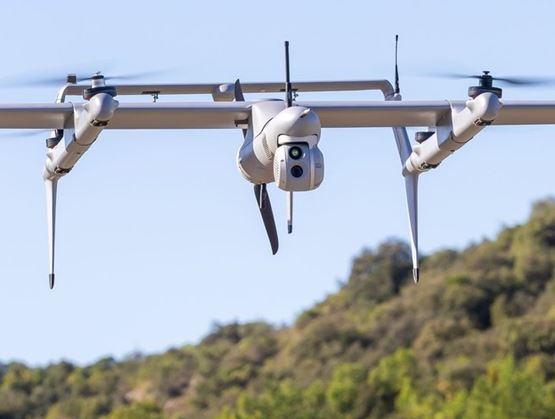
For border agencies, coastguards and other public-security organisations, the combination of a small footprint and live airborne imagery is significant. An aircraft that does not depend upon a runway, catapult or prepared recovery system can potentially be moved closer to the point where surveillance is required.
Combining Vertical Lift With Fixed-Wing Reach
The engineering approach seeks to retain the advantages of a fixed-wing aircraft while removing some of its deployment restrictions. The VTOL Aliaca uses four lift propellers for take-off and landing before transitioning to fixed-wing flight.
The latest configuration has a maximum take-off weight of 25 kg, a wingspan of approximately 3.6 metres and a length of 2.2 metres. Airbus currently presents two propulsion options. An all-electric version provides up to three hours of endurance and a 50 km data-link range, while a hybrid variant extends flight endurance to as much as six hours and its operational radius to 100 km.
Importantly, the vertical version does not represent an entirely new operating architecture. Airbus says it retains core elements including the autopilot, data link and ground-control approach. Each system contains two aircraft and a ground station, with flight and payload functions capable of being handled by two operators or, where required, by one person switching between the functions. Take-off and landing are automated, while missions can also be programmed in advance.
That continuity could ease the transition for existing users while reducing the infrastructure needed around the aircraft itself.
From Naval Aviation To Homeland Security
The French Navy’s adoption comes amid a much wider effort to integrate uncrewed systems across maritime operations. In October 2026, France’s Ministry of the Armed Forces outlined plans to accelerate the Navy’s use of naval drones, reflecting the increasing role of autonomous and remotely operated systems across contemporary maritime operations.
The Aliaca also points towards closer cooperation between crewed and uncrewed aviation. Airbus demonstrated the U010 operating alongside its larger U030 Flexrotor and an H130 helicopter during an exercise in October, part of work exploring how helicopters and drones can operate together.
For homeland security operators, however, some of the most immediate implications are less futuristic. Vertical take-off gives a proven surveillance platform access to smaller ships and more restricted sites. Coastal monitoring, border surveillance, search and rescue, environmental observation and the detection of illicit maritime activity all depend on gaining information quickly, often from locations where conventional aviation support cannot be permanently positioned.
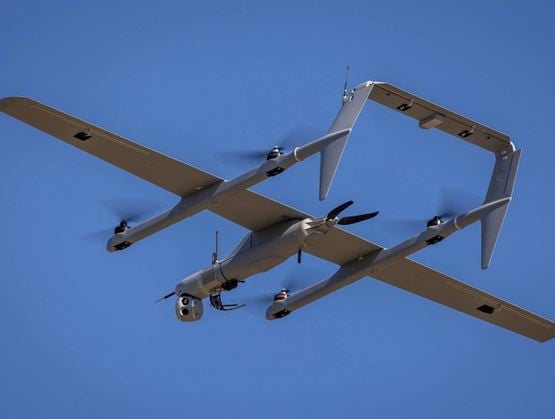
The development also falls within Airbus’s established presence in the international homeland security sector. The company exhibited at Milipol Paris 2025, where drones, robotics, border security and critical infrastructure protection formed part of the wider technology landscape, and was present again at Milipol Qatar 2026 in Doha.
That presence reflects the increasingly porous boundary between technologies developed for defence and those serving civil security, border management and crisis response. Small uncrewed aircraft are no longer confined to purely military reconnaissance roles. Their combination of persistent observation, rapid deployment and increasingly compact operating footprints is making them relevant to a much broader group of security authorities.
The U010 Aliaca’s transition to vertical operations illustrates that progression particularly clearly. Rather than radically changing the aircraft’s surveillance function, the new configuration changes where that capability can be deployed and the infrastructure required to support it. For public-security organisations seeking greater situational awareness at sea or along difficult coastlines, that may prove the more consequential development.
These questions around drones, maritime surveillance, border protection and interoperable security technologies remain closely aligned with the operational challenges addressed across the Milipol network and at Milipol Paris.