
Sayari: Mapping Hidden Risks Through Global Supply Chain Intelligence

Supply chains have always shaped national resilience, but today they sit at the crossroads of geopolitics, technology and security strategy. Supply Chain Risk Management (SCRM) has become a defining capability for governments and defence industries alike. A single weak link, such as an obscured beneficial owner, a sanctioned intermediary, or an unstable supplier jurisdiction, can jeopardise manufacturing cycles, operational readiness and regulatory compliance. As European defence industries prepare for sharply rising production demands, ensuring that each tier of their supply chains is transparent, trustworthy and resilient has become a core strategic priority.
In this environment, organisations increasingly rely on advanced data-driven tools to make sense of global corporate networks, trade flows and cross-border relationships. Sayari, a company that has spent more than a decade building a global knowledge graph for risk analysis, positions itself at the centre of this shift. By unifying billions of records from hundreds of jurisdictions, it aims to deliver the information advantage required to secure critical defence and homeland-security supply chains.
Mapping the Hidden Layers of Global Supply Chains
Modern defence production depends on thousands of direct and indirect suppliers. Many sit several layers removed from prime contractors and ministries of defence, making them difficult to identify, let alone assess. Sayari’s approach combines multilingual corporate registries, regulatory records, trade data, and open-source intelligence drawn from over 250 jurisdictions worldwide, helping users map these subtier networks with speed and consistency.
At the core of this capability is the company’s global knowledge graph, which links disparate data sources into resolvable entities and relationships. For procurement and due-diligence teams, this offers a way to uncover n-tier suppliers, identify ultimate beneficial owners, and understand how corporate structures extend across borders. The objective is not simply to gather data but to transform unstructured information into a form that can be systematically queried, tested and incorporated into risk-management frameworks.
This visibility supports key national-security priorities, including monitoring for foreign state-owned enterprise involvement, understanding intermediaries in high-risk jurisdictions, and identifying suppliers who are directly or indirectly connected to sanctions, export-control concerns or geopolitical exposure.
Anticipating and Mitigating Risk in Defence Supply Chains
As procurement cycles accelerate and defence ministries push for greater production capacity, the ability to make rapid, well-informed decisions becomes essential. Sayari’s platform aims to support this need by helping agencies and contractors detect potential vulnerabilities before they disrupt operations.
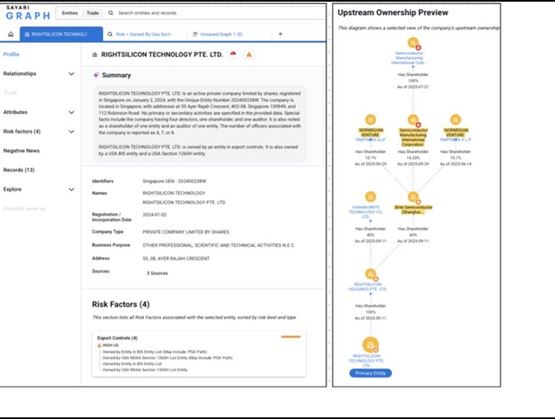
Foreign influence and investment.
Subtier supplier and geopolitical risk.
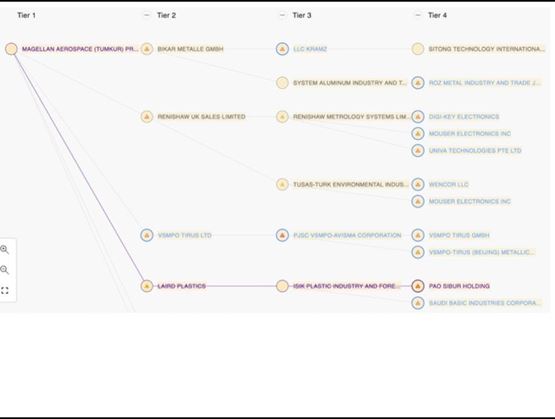
Data confidence and national security assurance.
One of the persistent challenges in national-security work is the reliability and interpretability of global data. Sayari addresses this by reconciling billions of multilingual records into structured, translatable entities. For analysts, this reduces the uncertainty that can accompany fragmented or inconsistent information and strengthens the evidentiary basis for procurement decisions.
Supply-chain resiliency and alternative-supplier identification.
In an era where political shifts, regulatory changes or logistical disruptions can rapidly affect sourcing, organisations need options. Sayari provides import–export insights covering more than 85 trade data sources worldwide. This allows procurement teams to identify viable alternative suppliers in key industries and jurisdictions, reducing downtime and supporting continuous production.
Serving Both Government and Industry
National-security supply-chain assurance is not the responsibility of governments alone. Defence manufacturers, technology suppliers and aerospace firms all depend on accurate, timely information to manage their own obligations and maintain continuity. Sayari works with public-sector agencies across Europe, North America and Asia, as well as private-sector organisations operating in sensitive industries.
This dual engagement informs how the company designs its tools: flexible enough to support investigative teams with complex analytical needs, yet intuitive enough to be integrated into procurement workflows. By aligning its capabilities with the requirements of regulators, investigators and industrial contractors, Sayari aims to strengthen the collective resilience of the defence and homeland security ecosystem.
Building Information Advantage for a More Complex Future
Europe’s defence sector is evolving quickly, shaped by geopolitical uncertainty, rising production targets and the growing interconnectedness of global supply networks. This creates both new opportunities and new vulnerabilities, particularly within the subtier layers that remain difficult to monitor.
In this environment, information advantage becomes a practical necessity rather than a strategic luxury. By consolidating global corporate, trade and ownership data into a structured, actionable format, Sayari offers organisations a way to strengthen procurement integrity and respond more confidently to emerging risks.
As governments and industry seek to reinforce supply-chain resilience, solutions that deliver clarity, traceability and timely insight will play an increasingly central role. Sayari’s work reflects this shift, helping defence and homeland-security stakeholders build supply chains that are both compliant and better equipped to navigate a rapidly evolving global landscape.