
How Business France Creates High-Value Connections

Can you tell us a little about the role of Business France in general and specifically in the security sector?
Business France is the government agency responsible for promoting the internationalisation of the French economy, with three main missions: Supporting French SMEs and mid-cap companies in their export development, prospecting and attracting foreign investors to France, and managing the V.I.E VIE International Internship Programme.
Business France has more than 1,400 employees working closely with businesses in 51 countries, covering approximately 110 countries.
Our role in supporting exports in the security sector is multifaceted. We identify and prioritise security needs around the world, inform French companies about these opportunities and support them in the right country and through the right format (French pavilions, B2B events, hosting delegations in France) in conjunction with our partners in the sector's ecosystem.
In 2024, Business France supported 145 companies in 12 collective operations in the security, defence and cybersecurity sectors. Individually, 200 companies in the sector received support.
How do you perceive the current international demand for French security solutions?
It is difficult to measure the evolution of exports in this sector because they often involve medium/long-term projects. What we are seeing at our level is growing demand from our foreign partners for physical, digital and cyber security solutions, and that France is recognised for its expertise and is therefore a trusted partner internationally.
How does Business France support French companies in developing their presence in international security markets?
Each year, Business France works in coordination with sector partners to prioritise countries where there are real business opportunities for French companies.
In the security and defence sector, this coordination is carried out in particular with the International Security Cooperation Directorate (DCIS), the French Directorate General of Armament (DGA), Security and Defence Cooperation Directorate (DCSD), the French trade association GICAT, the French Maritime Industry Association GICAN, and the French Federation of Fire Professions (FFMI), as well as with clusters such as SAFE Cluster, EDEN and Primus.
Abroad, Business France relies on its offices in 51 countries and on its network of Internal Security Attachés and Defence Attachés.
Once priority markets have been identified, an annual programme is put together: collective missions play an essential role in promoting French offerings, supporting companies from preparation through to post-event follow-up. This initial phase aims to confirm market potential, define priorities, identify local needs and major projects, mobilise strategic contacts, target relevant French companies and ensure effective communication.
Finally, rigorous follow-up of post-event contacts is essential to help French companies turn opportunities into long-term business.
In the security/defence sector, prior to planning these events, consultations are held between Business France teams (in France and abroad) and partners in the sector to prioritise the markets to target.
Once the priority countries have been identified, French Security Days (sometimes Defence Days) are organised in close collaboration with the DCIS Partnerships Office and the Internal Security Services of Embassies (also with the Defence Missions, depending on the target market).
The goal of these events is to strengthen economic and industrial ties in the areas of security and defence between French players and all local public and private stakeholders, promote France's image and highlight what French companies have to offer, but also to understand how the local market works and what its needs are.
They enable French companies to discover opportunities in the country, understand public sector procurement procedures, present their solutions to local authorities and companies, and find business partners.
In 2026, Business France will be organising 16 events in the security, cybersecurity and defence sectors.
This year's edition of Milipol Paris brought together high-level delegations from around the world. How does Business France facilitate connections between international buyers and French exhibitors?
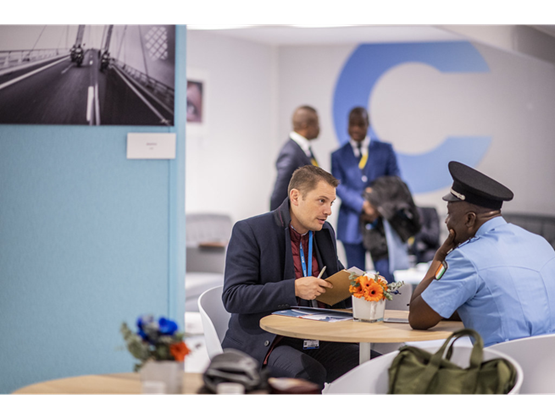
At Milipol Paris, Business France used its “Export Starts in France” initiative, which, thanks to our partnership with Comexposium, allowed us to invite a dozen foreign contractors from eight countries to the trade show to connect them with French companies and facilitate initial exchanges and potential partnerships. To do this, we set up a meeting platform on which 140 French companies were registered at the opening of the show. At Milipol Paris, around 200 meetings were requested via our platform throughout the week between French companies and major foreign accounts.
Throughout the exhibition, teams from Business France headquarters and our international offices were on hand to assist these clients and ensure that meetings ran smoothly.
Finally, Business France provided operational support to the DCIS in connecting certain foreign delegations with French companies.
Delegations that Business France worked with at Milipol Paris included:
- Belgium: Liège Airport Security
- United States: Los Angeles Police Department (LAPD)
- Canada : Aéroport de Montréal
- Poland: PERN, Polskie Sieci Elektroenergetyczne S.A. (PSE) and the Polish Platform For Homeland Security
- Tunisia: Ministry of the Interior
- Ukraine: State Border Guard Service of Ukraine – DPSU
- Ivory Coast: Autonomous Port of San Pedro
- Brazil: several Brazilian police delegations
Do you think there are any specific areas or sectors that offer promising export opportunities in the near future?
Certain areas are regularly identified in terms of international needs, in a particularly uncertain geopolitical and security context. Sectors offering promising opportunities include airport security, drone systems – including autonomous, flying or ground-based platforms – and anti-drone solutions. Other areas include physical and cyber security for energy infrastructure, whether perimeter protection, detection, access control, network surveillance or attack prevention. There is also a need for surveillance and supervision tools, AI-based decision support solutions for law enforcement and crisis management, and advanced tools for combating cybercrime and data analysis.