
Discover How CodexScribe is Redefining Trustworthy AI

The Milipol Innovation Awards have long served as a barometer for technological progress in homeland security. Reserved for exhibitors, the competition recognises advances across five categories that reflect the sector’s evolving priorities, from cybersecurity and artificial intelligence to crisis management and responsible innovation. In 2025, amid intensifying scrutiny of digital systems and their reliability, the Cybersecurity and AI category underscored a decisive shift towards solutions that can be trusted not only to perform, but to prove their correctness.
It was in this context that Formal Foundry was awarded the top distinction for its CodexScribe solution. Positioned at the intersection of formal methods and artificial intelligence, CodexScribe addresses a persistent challenge in the deployment of AI systems within sensitive environments. Rather than relying on probabilistic prompts that can lead to ambiguity or inconsistency, the platform focuses on transforming expert knowledge into verifiable, machine-checkable rules.
From Prompts to proofs: Redefining AI Reliability
The increasing integration of AI into homeland security operations has exposed a structural limitation in current approaches. Large language models, while powerful, remain inherently probabilistic. Their outputs, shaped by prompts, can vary in subtle yet critical ways. For sectors where accountability and precision are essential, such variability introduces unacceptable risk.
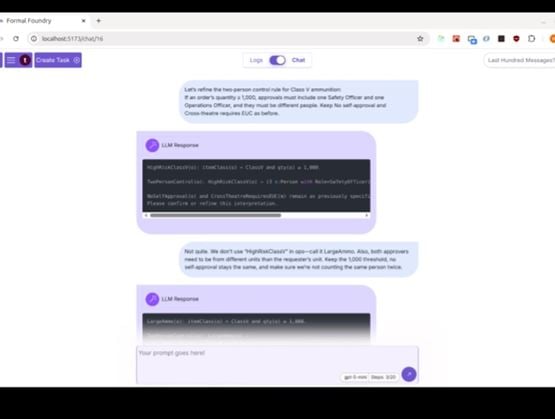
CodexScribe proposes an alternative grounded in formal verification. The system translates human intent into structured specifications that can be validated within a proof assistant. This process creates a closed loop in which rules are not only defined but mathematically verified, ensuring that outputs remain consistent and aligned with their intended logic.
According to the company, this approach allows organisations to move away from brittle prompt engineering towards durable rule-based systems. These rules are expressed in a way that machines can rigorously interpret, while also being translated back into clear, human-readable language. The result is a dual layer of transparency that supports both technical validation and operational understanding.
This distinction is particularly relevant in contexts such as intelligence analysis, legal compliance, and operational planning, where decisions must be traceable and defensible. By embedding verification into the development process, CodexScribe enables systems that can demonstrate not only what they do, but why they do it.
Aligning with European Regulatory Expectations
The emergence of CodexScribe also reflects a broader regulatory shift within Europe. The EU AI Act has introduced new expectations around transparency, accountability, and risk management for AI systems, particularly those deployed in high-risk fields. Organisations are increasingly required to produce evidence demonstrating that their systems behave as intended and comply with defined standards.
CodexScribe has been designed with these requirements in mind. Its architecture generates traceable artefacts that document the logic and validation of each rule. These artefacts can serve as evidence in audits or compliance assessments, addressing a key challenge for organisations seeking to operationalise regulatory frameworks.
The platform’s compatibility with European large language models, including Mistral, Magistral, PLLuM, and Bielik, further reinforces its alignment with regional priorities. As European stakeholders seek to reduce dependence on external technologies and strengthen digital sovereignty, solutions that integrate with locally developed models are gaining strategic importance.
Equally significant is the system’s deployment flexibility. CodexScribe can operate on an organisation’s own infrastructure, including in restricted or air-gapped environments. This capability is essential for defence, law enforcement, and critical infrastructure operators, where data sensitivity and operational security often preclude the use of cloud-based services.
By combining formal verification with adaptable deployment, the platform addresses both the technical and organisational dimensions of trust in AI systems.
Operational Impact in Mission-critical Environments
Beyond compliance, the practical implications of CodexScribe lie in its ability to standardise and preserve expertise. In many security organisations, critical knowledge is distributed across individuals and teams, often captured in informal processes or documentation. This fragmentation can lead to inconsistencies, particularly when personnel change or systems evolve.
CodexScribe converts this tacit knowledge into explicit, machine-checkable rules that persist over time. These rules can be shared across teams and integrated into workflows, ensuring continuity and reducing the risk of misinterpretation. The platform’s emphasis on clarity and auditability also supports collaboration between technical and non-technical stakeholders, bridging a gap that often complicates the adoption of advanced technologies.
In operational terms, this translates into more predictable system behaviour and faster validation of new processes. For example, in crisis management scenarios, where decisions must be made rapidly under pressure, having pre-verified rules can enhance both speed and confidence. Similarly, in cybersecurity operations, formally defined response protocols can reduce ambiguity and improve coordination.
The emphasis on closed-loop verification also introduces a feedback mechanism that strengthens system resilience. By continuously validating rules against defined criteria, organisations can identify and correct discrepancies before they propagate into operational failures. This proactive approach aligns with a broader shift towards resilience and preparedness within the homeland security sector.
The recognition of CodexScribe at the Milipol Innovation Awards reflects a growing consensus that trust in AI must be engineered, not assumed. As systems become more complex and their applications more consequential, the ability to verify their behaviour will become a defining factor in their adoption.

In this context, the success of Formal Foundry highlights an emerging paradigm in which AI is not only intelligent but accountable. By grounding machine behaviour in formally verified rules, CodexScribe offers a pathway towards systems that can meet the stringent demands of security, compliance, and operational reliability.
As the homeland security community continues to navigate the opportunities and risks of artificial intelligence, innovations such as CodexScribe are likely to play a central role in shaping the next generation of trusted systems. These developments will undoubtedly be closely followed at future editions of Milipol Paris, where the convergence of technology and security remains at the forefront of international attention.
Image credits:
Steve Johnson - Unsplash
Formal Foundry