
SMPP and KNDS Formalise KATANA Teaming Agreement

Milipol Paris 2025 provided the setting for a significant new collaboration between India and Europe’s defence industries. On 20 November, SMPP and KNDS signed a teaming agreement centred on the KATANA precision-guided artillery ammunition range, signalling a shared ambition to support advanced 155 mm capabilities for the Indian Armed Forces. The announcement took place during a landmark edition of Milipol Paris, which hosted more than 1,100 exhibitors and over 32,000 visitors and remains a global reference point for homeland security and safety innovation.
The agreement aligns directly with India’s long-running “Make in India” initiative, which promotes domestic manufacturing, technology transfer and industrial capability building. According to both companies, the partnership will prioritise introducing the KATANA family of ammunition to the Indian Army at a time when its requirements for modern 155 mm systems and precision rounds are both extensive and urgent.
Expanding India’s defence manufacturing base
SMPP is one of India’s long-established defence and aerospace manufacturers, founded in 1985 and headquartered in New Delhi. The company has grown from a specialist producer of aluminium alloy components into a diversified supplier whose portfolio now spans personal and platform ballistic protection, advanced armour systems and ammunition components. Its manufacturing footprint includes modern facilities in Haryana and Himachal Pradesh, with capabilities that cover design, engineering, materials processing and end-to-end production for defence applications. According to the company, its strategic direction has increasingly centred on technologies that contribute to India’s long-term defence preparedness, including areas aligned with artillery modernisation and survivability.
The teaming agreement with KNDS marks a further step in this evolution. By integrating a European precision-guided ammunition family within India’s industrial ecosystem, SMPP aims to support the development of an indigenous production line capable of supplying large volumes of advanced 155 mm rounds. This approach reflects the Indian government’s emphasis on reducing external dependency while positioning national manufacturers as partners in major global defence programmes.
For SMPP, the collaboration also represents an entry into a highly specialised domain that complements its existing expertise in protection technologies. The company notes that its longstanding work in ballistic materials and its established industrial base constitute strong foundations for broadening into precision-guided ammunition manufacturing and integration.
KNDS brings a mature European artillery ecosystem
KNDS is the result of the association between Krauss-Maffei Wegmann of Germany and Nexter of France, two of Europe’s leading land defence manufacturers. The group employs over 10,000 people and recorded a 2024 turnover of €3.8 billion. Its product portfolio encompasses main battle tanks, armoured vehicles, artillery systems, weapons, ammunition, bridges, protection solutions, training systems and digital command tools.
The company’s ammunition division, KNDS Ammo France, acts as a prime contractor and system integrator within a broader European industrial framework. According to KNDS, the KATANA programme was developed to meet a growing operational need for high-precision, long-range artillery capabilities that allow armed forces to neutralise targets with minimal collateral impact.
The KATANA family currently includes the Ballistic Range, Extended Range and High Precision variants. The ammunition uses a hybrid guidance system combining a multi-constellation GNSS receiver with an Inertial Measurement Unit to achieve accuracy across a wide range of terrains and operational environments. The round can strike targets at distances beyond 40 kilometres while maintaining deca-metric precision, making it suited to engagements requiring controlled effects at extended ranges.
A future variant is expected to incorporate a semi-active laser seeker for metric-level precision. The family also includes fire-and-forget functionality for complex environments, such as dense urban terrain where accuracy and controlled lethality are essential. By offering multiple guidance modes, including GPS, inertial navigation and semi-active laser options, KATANA is designed to adapt to rapidly changing battlefield conditions and deliver effects with sub-meter accuracy in its high-precision configuration.
Aligning precision artillery with India’s strategic requirements
India’s armed forces are undergoing a broad modernisation effort across their artillery inventory, with particular emphasis on 155 mm systems and high-performance guided munitions. The teaming agreement between SMPP and KNDS is therefore structured around enabling the KATANA family to be produced and supported in India in accordance with national procurement policies.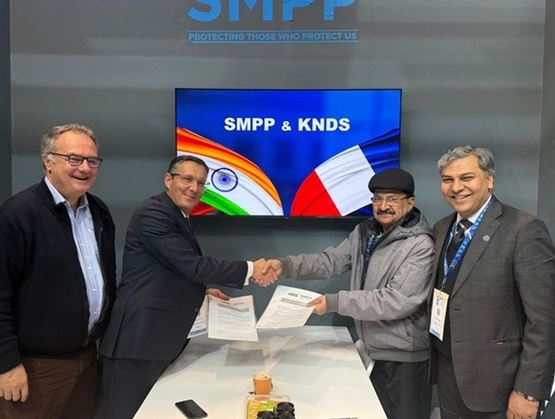
The collaboration also reflects the broader global trend towards precision artillery as armed forces seek tools that enhance operational flexibility while limiting unintended damage. High-accuracy rounds such as KATANA reduce the need for massed fires, improve agility in mobile operations and allow for precise effects in contested or populated areas.
At Milipol Paris, the agreement drew attention partly because it links two industrial ecosystems that have been expanding their international cooperation. SMPP continues to broaden its technical portfolio within India’s defence sector, while KNDS maintains an active strategy of forming partnerships that adapt European technologies for regional requirements. For both companies, the initiative represents a route to long-term industrial collaboration supported by clear operational needs and policy alignment.
As India progresses its artillery modernisation roadmap, the partnership positions SMPP and KNDS to contribute a precision-guided solution designed to enhance accuracy, extend reach and minimise collateral effects. With Milipol Paris as its backdrop, the agreement underscores how international cooperation continues to play a central role in shaping the future of artillery and land-defence capabilities.