
inside the moving security bubble

When Pope Leo XIV travelled through France from 25 to 28 September 2026, the four-day visit presented French authorities with a complex protection challenge. Paris, Lourdes and Metz offered three very different operating environments, while large crowds, religious gatherings, official meetings and movements between cities meant that security could never be confined to a single perimeter.
Around 15,000 personnel were mobilised in Paris on 25 and 26 September, including police officers, gendarmes, mobile units and soldiers from Operation Sentinelle. Specialist capabilities included bomb-disposal experts, snipers, motorcycle units and intervention forces from the BRI, RAID and GIGN. Lourdes received more than 3,000 security personnel, while Metz deployed thousands of police officers and gendarmes around the papal route and cathedral.
Behind those visible deployments was a broader protective system designed to accompany the Pope from arrival to departure.
Building A Moving Security Bubble
Protecting a dignitary begins long before the motorcade appears. French authorities conducted reconnaissance of sites and routes with the Pope’s own security personnel, the Swiss Guard and Vatican gendarmerie. Protective perimeters were established around events, with searches and physical screening required for entry into designated areas.
Movement itself required another layer. Gendarmes secured airports at Metz-Nancy-Lorraine, Vatry and Tarbes-Lourdes-Pyrénées, controlled flows, protected routes and provided escorts. In Paris, motorcycle units escorted the papal delegation from Orly Airport to the Élysée Palace. Up to 6,000 gendarmes were mobilised each day across the visit, supported by 70 mobile gendarmerie squadrons and specialist capabilities including explosive detection, canine teams, CBRN resources, counter-drone systems and waterborne units.
The protective bubble also extended upwards. Around 250 French Air and Space Force personnel participated in special air-security arrangements covering Paris, Lourdes and Metz, while Rafale fighters escorted the Pope’s flight between Lourdes and Metz.
The result illustrates the central principle of modern dignitary protection: close protection is only the innermost layer. Security also depends upon intelligence, transport control, public-order management, specialist intervention teams, emergency response and protection of the surrounding airspace.
From Bodyguards To Intelligence Networks
France’s Protection Service, the SDLP, provides a useful illustration of how these responsibilities have expanded. Its 1,471 personnel encompass close-protection officers, security drivers, operational coordination and specialist support. Security drivers are expected not simply to transport a protected person but to minimise exposure to potential attacks and enable rapid evacuation if necessary. The service also prepares major international events and protects particularly threatened foreign personalities visiting France.
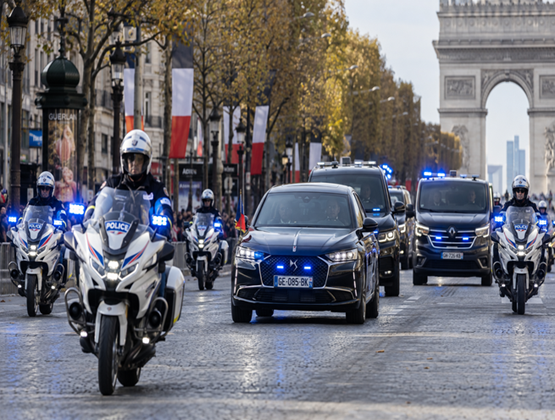
Such arrangements increasingly depend upon information gathered before an event. Threat assessments can shape everything from routes and motorcade composition to accreditation, crowd-control measures and deployment of specialist units.
At the 2026 G7 summit in Évian-les-Bains, preparations extended over several months and included territorial intelligence assessments as authorities considered risks ranging from public-order incidents to threats in the cyber domain. Around 6,100 gendarmes were involved, alongside a major police deployment.
The summit’s geography also demanded protection across land, water and air. Approximately 100 gendarmes and 18 vessels operated on Lake Geneva, while seven gendarmerie aircraft were deployed as part of the aerial operation, together with drones and counter-drone capabilities.
When Dozens Of Motorcades Converge
The challenge multiplies when one protected visitor becomes dozens. Few events illustrate this better than the United Nations General Assembly High-Level Week in New York, where heads of state, heads of government, ministers and their security details converge within a relatively small area.
Protection there relies on close coordination between UN security, US authorities, the New York Police Department and visiting national security teams. Preparations include specific security risk assessments, vulnerability exercises, bomb sweeps, checkpoints, evacuation planning and coordination of traffic and motorcade movements.
Figures from the 77th General Assembly demonstrate the scale. UN security assisted 140 heads of state and government, 63 foreign ministers and 34 other VIPs, while 745 motorcades were admitted into the UN Headquarters compound. A Joint Operations Centre brought US agencies and UN security representatives together to coordinate activity.
Outside UN premises, the US Secret Service takes the primary role in protecting VIPs, while UN close-protection personnel assume significant responsibilities within the complex. Restricted zones, screening points, CCTV surveillance and perimeter security allow dignitaries to move through the site while remaining within successive layers of protection.
Protection Without Paralysis
The difficult balance is maintaining security without bringing an entire city to a halt. Motorcades need clear routes, yet residents need access. Protective perimeters must restrict movement without preventing legitimate activity. Crowds represent both the purpose of many high-profile visits and one of their greatest security complexities.
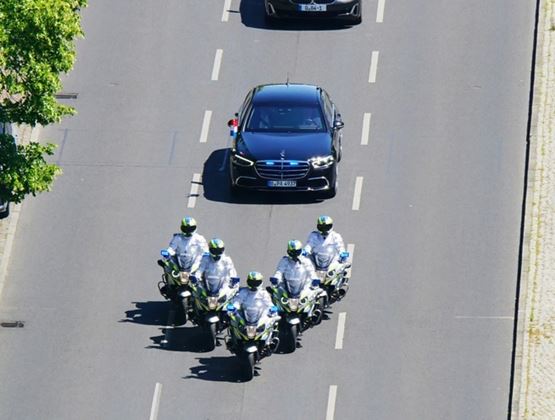
Technology is adding further dimensions. Drones have created an accessible aerial threat, while counter-drone systems, surveillance platforms and secure communications have become increasingly important. At the same time, the fundamentals remain recognisable: advance reconnaissance, intelligence, controlled access, reliable communications, trained drivers, specialist intervention teams and carefully coordinated command structures.
High-profile visits therefore provide a concentrated view of contemporary homeland security. A few seconds of footage showing a dignitary stepping from an armoured vehicle can conceal months of preparation and a security architecture stretching across roads, buildings, airports, waterways, digital networks and airspace.
As governments prepare for increasingly complex international gatherings, the technologies and operational methods behind that architecture will remain an important field for security professionals. These capabilities, from protective mobility and communications to counter-drone technology, surveillance and crisis management, form part of the wider security ecosystem represented at Milipol Paris and Milipol Network Events, including Milipol Qatar, taking place in Doha from 20 to 22 October.
Image credits:
Martti Salmi - Unsplash
Yewen - Unsplash