
Regional Cooperation Strengthened at Nairobi Anti-Trafficking Forum

Building a framework for joint action
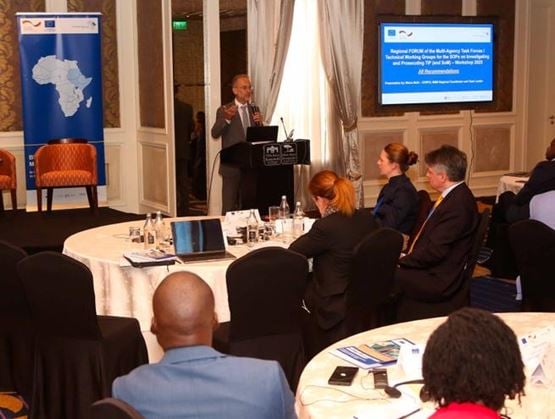
In May 2025, Nairobi hosted the third Regional Forum of the Multi-Agency Task Forces and Technical Working Groups for the implementation of Standard Operating Procedures (SOPs) on Investigating and Prosecuting Trafficking in Persons and Smuggling of Migrants. Organised by CIVIPOL under the Better Migration Management (BMM) Programme, with support from the European Union and the German Federal Ministry for Economic Cooperation and Development, the forum brought together close to ninety participants from Djibouti, Ethiopia, Kenya and Uganda.
The Forum was organised in close collaboration with the Regional Operational Centre in Khartoum (ROCK) Project, another EU-funded initiative implemented by CIVIPOL. Both programmes form part of a broader regional architecture that links criminal justice, immigration and financial intelligence services to strengthen the fight against human trafficking and smuggling.
The event marked another milestone in a regional effort that is reshaping how governments, law enforcement agencies and civil society tackle the complex web of human trafficking. Since the inaugural meeting in 2022, the initiative has expanded both in scale and ambition, strengthening a coordinated, rights-based approach that places victims and survivors at the centre.
Representatives from financial intelligence units, labour inspectorates, judicial bodies and referral mechanism coordinators joined regional partners including the East African Police Chiefs Cooperation Organisation (EAPCCO) and INTERPOL. Together, they explored practical strategies to harmonise investigations, share intelligence and operationalise SOPs that ensure consistent and effective responses across borders.
The Better Migration Management Programme
At the heart of this regional collaboration lies the Better Migration Management (BMM) Programme, a cornerstone initiative designed to promote safe, orderly and regular migration in the Horn of Africa. Funded by the EU and the German Federal Ministry for Economic Cooperation and Development (BMZ) and implemented by a consortium led by Deutsche Gesellschaft für Internationale Zusammenarbeit (GIZ) GmbH alongside partners such as the British Council, the International Organization for Migration and the United Nations Office on Drugs and Crime, BMM works across three pillars: migration governance, institutional strengthening, and victim protection.
CIVIPOL, as one of the implementing partners, focuses on improving the quality of investigations and prosecutions of trafficking and smuggling cases while ensuring the referral of victims to adequate protection and assistance services. Through training curricula for police academies, simulation-based exercises, and multi-agency collaboration, the BMM provides the tools and frameworks needed to make cooperation sustainable.
A central element of this effort is the Standard Operating Procedures, developed to harmonise investigative and prosecutorial methods among countries in the region. They promote a trauma-informed, gender-sensitive approach and establish clear links with national and res in Nairobi delved into the operationalisation of these tools. Topics included cross-border investigations, financial intelligence for dismantling criminal networks, the role of labour inspection in identifying exploitation, and responses to emerging threats such as online recruitment and technology-enabled trafficking. The participants underscored the need to continuously adapt the SOPs to reflect the evolving landscape of trafficking and migration crimes.
The ROCK Project:Linking intelligence across borders
Complementing these efforts, the EU-funded Regional Operational Centre in Khartoum (ROCK) project represents a vital operational dimension in the regional fight against trafficking and smuggling. Initially launched in 2017 under the Khartoum Process and the African Union’s Horn of Africa Initiative, the ROCK was designed to enhance the exchange of police information among law enforcement agencies from eleven countries including Djibouti, Egypt, Ethiopia, Kenya, Somalia, Sudan and Uganda.
Implemented by CIVIPOL, the ROCK serves as a hub where liaison officers from participating countries collaborate in real time to track and dismantle criminal networks. The project was established to strengthen the investigative capacities of national police forces, particularly their criminal investigation departments. By pooling intelligence and coordinating operations, it helps curb the profits of organised networks whose activities Europol estimated at up to €5.7 billion annually.
A shared commitment to human security
The Nairobi forum concluded with renewed commitments from national authorities and regional partners. Delegates called for the institutionalisation of the SOPs checklist as a monitoring tool, the creation of operational contact networks, and the establishment of joint investigation teams supported by INTERPOL, UNODC and CIVIPOL. Participants also advocated for integrating financial intelligence units into cross-border operations and expanding joint training curricula to include simulation-based exercises that replicate real-life trafficking scenarios.
A recurring theme throughout the discussions was the need to link prosecution with protection. Ensuring that victims of trafficking can access justice and assistance remains central to the collective effort. This includes advancing legal frameworks for witness protection and adopting non-punishment clauses for victims coerced into criminal activities.
As the participants left Nairobi, they carried not only technical recommendations but also a shared sense of purpose: that through cooperation, the Horn of Africa can strengthen its resilience against trafficking and exploitation.
The fight against organised crime and human trafficking depends on such multi-agency partnerships built on trust, intelligence sharing and mutual accountability. These same principles will be showcased at Milipol Paris 2025, where international experts and security professionals will continue the dialogue on protecting human security worldwide. For more information, visit www.milipol.com.