
Technological Sovereignty and AI Governance

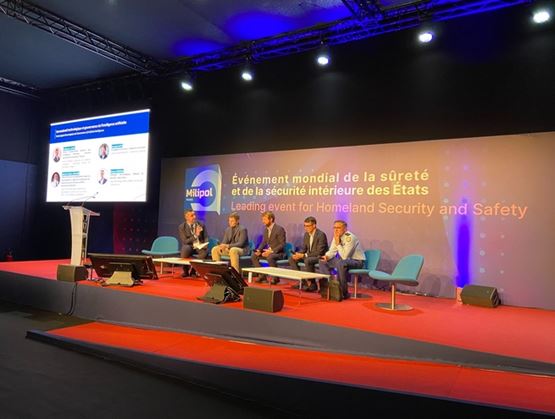
The moderator of the session, François Lempereur, journalist and founder of the communications agency POP COM, opened the discussion with a definition of sovereignty before inviting each speaker to explore the concept through their own professional experience. From the outset, the exchanges made clear that technological sovereignty in the field of artificial intelligence is less about isolation than about the ability to understand, choose and manage dependencies in a controlled and transparent way.
General Cédric Collard, Head of Command Support Applications at the Digital Agency for Internal Security Forces (ANFSI) of the French National Gendarmerie, approached the issue through a concrete operational case. He guided the audience through the challenge of transcribing interviews with child victims, a process that is strictly regulated within the criminal justice framework. Each interview must be filmed and transcribed in full, yet only around 10% of investigators are qualified to carry out this work. In practical terms, one hour of recorded testimony typically requires around eight hours of transcription.
Sovereignty grounded in operational reality
The aim of testing an AI-based transcription solution was not to replace investigators, but to determine whether part of this workload could be reduced so specialists could focus on other core aspects of their role. Tests carried out in 2023 showed that while human oversight remained essential, transcription time could be reduced to around three or four hours per hour of recording. In January 2025, the solution was rolled out across police and gendarmerie forces. With between 3,000 and 4,000 hours of interviews conducted each month, this represents an average saving of 12,000 to 15,000 working hours per month.
The discussion also highlighted several practical challenges encountered during deployment. Identifying speakers, particularly in interviews involving minors, proved complex, while designing interfaces closely aligned with investigators’ workflows was essential to ensure adoption. Computing power also emerged as a constraint, prompting the gendarmerie to develop an internal GPU infrastructure that could be supervised and maintained in-house, allowing the solution to scale without compromising data security.
Measuring trust and choosing the right tools
Simon Marsol, Chief Technology Officer Defence and Security at Sopra Steria, followed by stressing the importance of performance measurement in governance. According to Marsol, organisations risk undermining sovereignty if they automatically select the largest or most expensive AI models without assessing whether they are suited to a specific use case. He warned that the race for ever more powerful models can quickly lead to oversizing infrastructure and escalating costs, particularly in environments where trust and robustness are as critical as raw performance.
Marsol also highlighted the challenge of working with data at the scale of an entire ecosystem on a French or European scale. He cited health research as an example where progress depends on sharing data across borders, while ensuring that sensitive information remains protected. The same logic applies to defence and security, where biometric data, intelligence or cyber information may need to be analysed collaboratively. In such cases, data sovereignty must be considered at a European level, supported by exchange mechanisms that define precisely what can be shared, under which conditions and for what purpose.

Governance that lasts beyond technology cycles
Mr Latil also underlined the importance of risk-based governance. Not all AI use cases carry the same level of risk, and regulation should reflect this distinction. He argued that while technology evolves rapidly, legal frameworks should be designed to endure. “For a law to last, it is important to think long term,” he explained, suggesting that constantly rewriting rules in response to technological change could weaken trust rather than reinforce it.
Guillaume Avrin, former National Coordinator for Artificial Intelligence at the French Directorate General for Enterprises, expanded the discussion to include industrial strategy. He described sovereignty in terms of self-sufficiency and technical building blocks, acknowledging that in some areas Europe may need to develop its own solutions to align with its values and strategic interests. In other cases, where investment requirements are too high, limiting dependence on a single actor by diversifying suppliers and investors can be an effective alternative.
Mr Avrin illustrated this point by referring to major data centre investments announced in early 2025, totalling around £92 billion (€107 billion). He noted that the diversity of investors involved reduces the risk associated with reliance on one country or company. “Because if one of them cuts us off, we can always fall back on the other producers of these technologies,” he said. He also introduced the idea of interdependence, where countries accept reliance on certain components while remaining indispensable in others, creating a balance that supports strategic autonomy.
The session concluded with questions from the audience, including discussions on acceptable dependencies beyond Europe and the importance of accompanying AI deployment with training. Several speakers returned to the central role of humans in the loop, stressing that tools designed without regard for users’ real needs risk poor adoption or the emergence of unregulated workarounds.
The exchanges reinforced Milipol Paris’ position as a forum where abstract debates on technology are anchored in operational reality. By examining sovereignty through concrete use cases, governance frameworks and long-term strategy, the session highlighted how artificial intelligence can be integrated into homeland security in a way that builds trust, preserves control and supports those working on the ground.
Image credits:
Nahrizul Kadri - Unsplash
Anne-Emmanuelle Thion - Milipol Paris 2025