
INTERPOL and the Challenge of Identifying Missing Persons

Speaking in the afternoon of the second day of Milipol Paris 2025, François-Xavier Laurent, DNA Database Manager at INTERPOL, provided an in-depth look at how international information-sharing is transforming the identification of missing persons. The conference programme featured a wide range of operational insights, yet this session stood out for the clarity with which it illustrated the human impact of cooperation. Laurent opened by observing that missing persons cases are “a global problem,” and he explained that while most disappearances are resolved within hours or days, many remain unsolved for years. He emphasised that a growing proportion of cases contain cross-border elements linked to tourism, migration, organised crime or conflict, which means that national authorities cannot address them alone.
Laurent described how INTERPOL’s role is to provide the legal and technical infrastructure that allows its 196 member countries to exchange sensitive biometric information securely. Through National Central Bureaus, police forces can circulate Yellow Notices for missing persons and Black Notices for unidentified bodies. These notices contain descriptions, photographs and biometric identifiers and are transmitted instantly worldwide. As Laurent explained, “all the relevant information is sent immediately to the other 195 member countries,” enabling every national police service to compare the notice with its own records and databases.
The expanding reach of iFamilia
A major focus of the session was iFamilia, INTERPOL’s global DNA matching system dedicated to missing persons. Laurent described it as a mechanism that offers “a second chance” once national investigations have stalled. Countries can submit post-mortem DNA belonging to unidentified bodies or the genetic profiles of relatives searching for missing family members. The system then performs rapid scientific comparisons, using likelihood ratios and other statistical models to assess whether the profiles may belong to the same biological family. INTERPOL conducts the full analysis, provides the scientific interpretation and manages the cross-border notification process.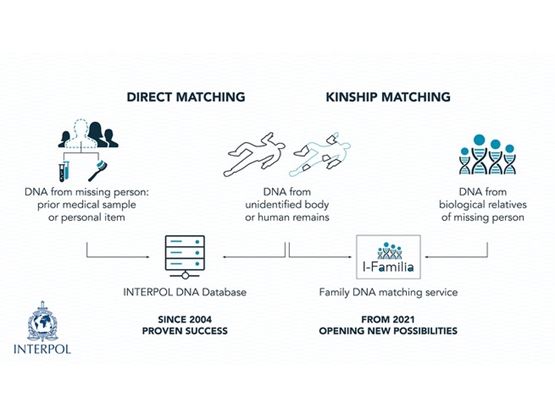
He also noted recent international successes that extended beyond Europe. New matches have taken place between Russia and the United States, Ireland and the United States, Morocco and Slovenia, and cases involving migrants whose journeys ended tragically before reaching Europe. More than 100 countries now contribute profiles to INTERPOL’s DNA databases, with some nations working toward supplying every missing person and unidentified body profile they hold. For Laurent, this commitment to routine data-sharing is essential, as “you never know if the person you are looking for is still in your country.”
Public engagement and the impact of the Identify Me campaign
The session also highlighted the impact of Identify Me, a Europe-wide initiative launched to draw attention to 46 unidentified women whose bodies have been found across the continent over the past four decades. Laurent explained that focusing on a small but emblematic group of cases can galvanise public interest and generate investigative leads that might otherwise never come to light. The campaign presents each case with descriptions, photographs, reconstructed images and details of personal items found with the victims. Members of the public can examine these files on INTERPOL’s website and submit observations or potential leads directly to police or to INTERPOL.
The results have been immediate. Since the launch of Identify Me, the campaign website has received more than four million views and thousands of messages from the public. The initiative has also been widely covered by television, radio and online media, creating what Laurent described as a snowball effect, as more visibility produces more leads and increases the likelihood that someone will recognise a detail that matters.
These efforts have already produced concrete identifications. One of the first was Rita Roberts, a British woman whose body was found in Belgium in the 1990s. Her family recognised her distinctive tattoo on a reconstruction published through the campaign and contacted INTERPOL within days. Subsequent collaboration between Belgian and British police confirmed the match. More recently, identifications have been made of a Paraguayan woman found in Spain and women whose remains in Europe could finally be linked to records held in Türkiye and Germany. Each case, Laurent explained, demonstrates how international data-sharing and public participation can close gaps left by decades of investigative effort.
Maintaining momentum in international cooperation
Laurent concluded by insisting that the tools now available must be supported by updated legislation, sustained cooperation and clear communication. He pointed to Belgium’s recent legal reform, which for the first time permitted the country to share DNA profiles internationally. Within hours of the law coming into effect, Belgium transmitted hundreds of profiles to INTERPOL, allowing comparisons that produced an identification in a case that had remained open for 34 years. For Laurent, examples like these illustrate how international mechanisms can deliver answers within seconds once the necessary data is available.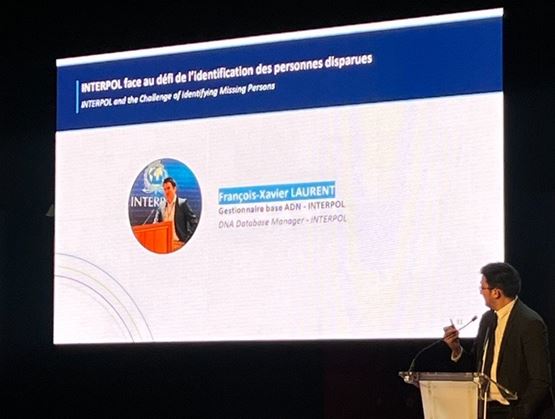
Image credit (IFamilia): INTERPOL