
CBRN Forensics and Laboratory Detection

Understanding CBRN and its growing significance
CBRN refers to threats involving chemical, biological, radiological or nuclear materials that can cause harm through deliberate use, accidents or industrial incidents. The term encompasses everything from toxic industrial chemicals and infectious pathogens to radioactive substances and fissile material. Once regarded as a narrow field confined to military specialists, CBRN is now a major concern for law enforcement, emergency services and public-health authorities.
The discipline of CBRN forensics has evolved to respond to this complex reality. Its central purpose is to determine whether CBRN materials have been used and, if so, to identify who was responsible. Establishing the truth is rarely straightforward. Chemical vapours disperse quickly, biological traces degrade, and radiation can be confused with natural background sources. A plume of smoke or unexplained illness may point to many possible causes, and sensor readings can be misinterpreted. Scientific verification, supported by credible forensic evidence, is therefore essential to confirm what actually occurred.
Verification and attribution
Verification of CBRN use is the first crucial step in any investigation. Forensic teams collect and preserve samples that may include gas residues, soil, liquids, surface swabs or biological matter. Their task is to determine if a harmful agent was present and to separate fact from assumption. In an age of social media, misinformation can spread faster than evidence can be gathered. Reliable forensic analysis provides the clarity needed for both public trust and international accountability.
Once the presence of a CBRN agent is confirmed, investigators must establish attribution. Determining who deployed or released a substance is often more complex than identifying the substance itself. The evidence may lie not in the agent, but in the fragments of a device, the trajectory of a munition, or the data on a mobile phone. Integrating CBRN science with traditional forensics (DNA, fibres, fingerprints and digital data) creates a complete picture of events. Every piece of evidence must be handled with precision and documented to preserve its legal value. A single procedural error or cross-contaminated sample can undermine the entire investigation. To ensure integrity, forensic teams use sterilised tools, sealed containers and control samples, maintaining a strict chain of custody from the field to the laboratory. The process must be robust enough to withstand scrutiny in court, as CBRN use may constitute a war crime or act of terrorism. Over the past two decades, specialised national and international capabilities have been established, from NATO’s Joint CBRN Defence Task Force, which supports efforts to prevent, protect against and recover from weapons of mass destruction attacks or CBRN events and SIBCRA (Sampling and identification of biological, chemical, and radiological agents) units to dedicated police CBRN divisions in several European countries.
From evidence to recovery
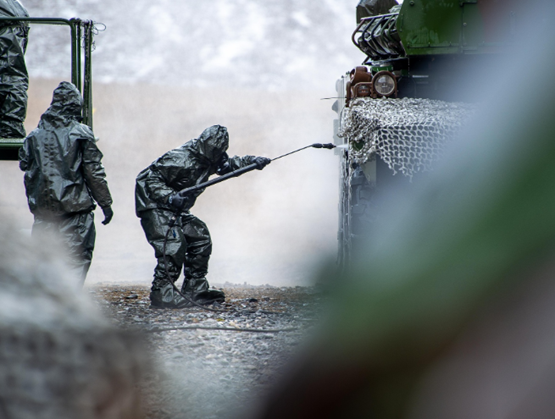
Beyond verification and attribution lies a third, equally critical phase: clean-up and decontamination. Once an incident has been contained, the priority becomes restoring safety for people, infrastructure and the environment. Decontamination ensures that personnel can operate safely, that contaminated vehicles or buildings can be reused, and that affected communities can begin to recover. It also protects investigators, since any mishandling of evidence or exposure to residual toxins can be dangerous long after the initial event.
Italian company Cristanini is a leading specialist in this field. Active for more than fifty years, the firm has built a reputation for developing reliable, field-ready solutions for CBRN decontamination and detoxification, as well as fire fighting systems. Its mobile laboratories and identification vehicles provide advanced analysis, monitoring and management capabilities in contaminated or high-risk environments. Designed for flexibility and autonomy, they allow rapid deployment wherever incidents occur.
Cristanini’s technologies include complete systems for the decontamination of vehicles, aircraft, buildings, equipment and personnel. These solutions are engineered for efficiency and safety, reducing downtime while ensuring that operators remain fully protected. Their universal decontaminant formulations are capable of neutralising chemical and biological agents and reducing radiological contamination. The company’s portable units are particularly suited for emergencies such as industrial accidents, environmental disasters or security incidents, where swift action is essential.
At Milipol Paris 2025 Cristanini will showcase its latest range of systems dedicated to CBRN decontamination and sanitisation. The company’s presence highlights the growing importance of recovery and resilience in the broader CBRN lifecycle. Clean-up is no longer a secondary consideration but a strategic capability in its own right. Without it, even the most advanced detection and forensic efforts cannot achieve their ultimate goal: the safe restoration of environments and the protection of those who serve within them.
CBRN challenges will continue to evolve, shaped by technological progress, industrial growth and global security dynamics. The combination of scientific rigour, operational readiness and innovative decontamination systems will remain the foundation of effective preparedness. Whether in the field, the laboratory or the courtroom, the ability to detect, verify, attribute and ultimately restore will define the future of CBRN resilience.